You have a camera, a topic you know well and a free Saturday. You hit record, talk for four minutes, watch it back and cringe. You wandered, you buried the best point at minute three, and the opening was "Hey guys, so today I wanted to talk about..." Nobody who scrolls past that opening is coming back.
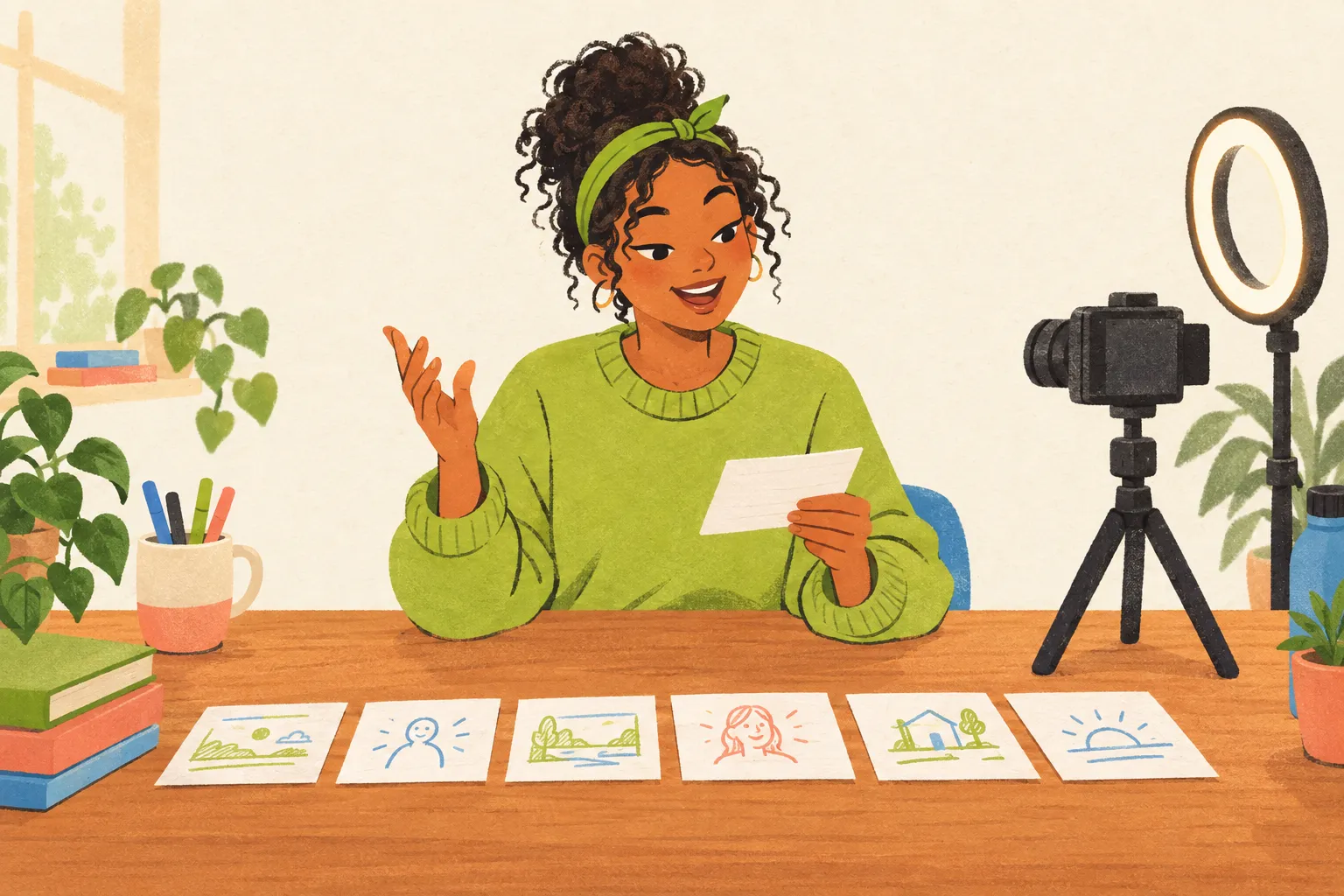
The fix is a script: not an essay you read like a hostage statement, but a plan for what the viewer sees and hears every few seconds, why they keep watching and what they do at the end.
AI is great at the grunt work: five hooks in ten seconds, a rambling outline turned into tight beats. It cannot know your audience or your voice. This guide shows you how to split that work. One note up front: Debatly writes and stress-tests scripts and makes thumbnail images. It does not generate video or voiceover; you film and edit with your own tools.
Choose the format
Every script problem starts as a format problem. A 45-second Short and a 12-minute tutorial are different animals, and "write a video script about X" gives you a mushy middle that fits neither. Decide the format, then give the AI the structure that goes with it.
| Format | Typical length | Structure | The one job |
|---|---|---|---|
| Short-form (Shorts, Reels, TikTok) | 15 to 60 seconds | Hook, one idea, payoff, loop or prompt | Stop the scroll and deliver one payoff |
| YouTube long-form | 6 to 20 minutes | Hook, promise, chapters with mini-payoffs, recap, next video | Keep the promise of the title and thumbnail |
| Explainer | 60 seconds to 3 minutes | Problem, why it happens, how it works, what to do | Make one concept feel simple |
| Ad | 15 to 30 seconds | Pain, product moment, proof, offer, call to action | Get one specific action |
Short-form has no room for setup: one idea per video, and if you have three tips, you have three videos. Long-form lives on the promise, so every chapter should pay off a little. Explainers work best when you name the confusion before you clear it up. Ads need one action and only one.
Your first prompt should set the format before any content. Use it in AI Chat or the AI Writer:
I am writing a [format] video, [length], for [who the viewer is and what they already know]. The one thing they should take away is [single idea]. The action at the end is [action]. Before writing anything, give me three different angles in one sentence each, and tell me which fits the format best and why.
Picking the right angle first saves you from polishing the wrong script.
Nail the first seconds
The hook is the first line and the first image together. On short-form it is the first second or two; on YouTube it is roughly the first 15 to 30 seconds. Either way it has three jobs: signal who this is for, open a question and make the answer feel worth waiting for.
Hook patterns that work
- The mistake: "You're grinding your coffee wrong, and it's not your beans' fault."
- The contrarian claim: "Stop making to-do lists. Do this instead."
- The result first: show the finished thing, then "Here's how I made this in 20 minutes."
- The specific number: "I tried three budgeting apps for a month. Only one survived."
- The pattern break: start mid-action, mid-sentence, with no greeting at all.
What kills a hook: greetings, channel intros, "in this video I'm going to," apologies and anything viewers have heard a thousand times ("Did you know...?").
Let AI give you volume, then choose yourself
Hooks are a numbers game, which is where AI shines. Ask for many, then filter hard:
Write 12 hooks for this video. Mix these patterns: mistake, contrarian claim, result first, specific number, direct question. Each hook must be under 12 spoken words and must pair with an opening shot, described in brackets after the line. No greetings, no "in this video", no questions that can be answered with "no".
Cut the list to three and read each one out loud. The one you can say without sounding like an announcer, and that makes you curious even though you know the answer, is usually the winner. Emma, the copywriter character, is a good sparring partner here: ask her to rank your three and explain what each one promises. If two still feel equally strong, test them.
Plan retention beats
A hook buys you a few seconds. Retention beats buy you the rest. A beat is a moment where something changes: new information, a visual switch, a question answered, a new question opened. When nothing changes for too long, thumbs move.
Before you write any dialogue, have the AI build a beat map: a numbered list of moments, each with a timestamp and one sentence. A 60-second Short might have five or six beats; a 10-minute video might have 20 to 30.
Here is my angle and hook: [paste]. Build a beat map for a [length] [format] video. Each beat gets a timestamp, one sentence on what the viewer learns or sees, and a note on what pulls them into the next beat (an open question, a visual reveal, a promise). Put the biggest payoff late, but give a small payoff within the first 20 percent.
Beats that reliably hold attention:
- Open loops: raise a question early, answer it later. "The third fix is the one nobody talks about."
- Mini-payoffs: on long videos, give something useful every minute or two.
- Visual changes: a cut, a close-up, on-screen text, a before and after. Plan them in the script, not the edit.
- Stakes: what goes wrong if the viewer ignores this? A ruined batch, a wasted afternoon.
- Re-hooks: restate the promise before the middle drags. "That fixes the taste. Now the part that saves you money."
The most common beat mistake is front-loading context: "Before we start, a bit of background" is where viewers leave. Put your strongest point last and your second strongest first.
Write for the ear
A script is heard, not read. AI drafts often sound like blog posts because that is much of what models learned from. Your job is to turn written language into spoken language.
- Short sentences. One idea each. If you need a breath in the middle, split it.
- Contractions. "You're," "it's," "don't." Nobody says "do not" unless they are annoyed.
- Concrete words. "A dense, gummy loaf" beats "suboptimal results."
- Spoken numbers. "About half," not "48.7 percent."
- Signposts and repetition. "First," "here's the catch," "last one." Listeners cannot scroll back up, so repeat the key phrase.
Rewrite this script for the ear. Short sentences, contractions, concrete words, nothing I would not say out loud to a friend. Keep my meaning and my examples. Mark any line that is hard to say in one breath with [BREATH], and flag any sentence over 15 words.
Then read all of it out loud at filming speed. Wherever you stumble, rewrite. For a second pair of eyes, AI writing feedback gives line-by-line critique.
Use the two-column format
The classic layout: what the viewer sees on the left, what they hear on the right, row by row with timestamps. It forces you to plan visuals with the words and doubles as your shot list.
Turn this spoken script into a table with three columns: Time, Visual, Audio. Every row covers 3 to 8 seconds. In Visual, describe the shot, any on-screen text and any B-roll I need to capture. Keep Audio word for word.
Paste the table into a doc and tick off each visual as you shoot it. The example below shows what a finished one looks like.
Worked example: 60 seconds
Jana runs a small channel about better coffee at home. Her viewers own a grinder and a pour-over cone but think the answer to bad coffee is pricier beans. She wants a 60-second Short that sends people to her longer grind-size video.
Step 1, format and angle. Short-form, 60 seconds, one idea: grind size matters more than bean price. Action: watch the full video. Of three angles the AI suggested ("the cheap bean test," "the grind mistake," "what baristas check first"), she picked the grind mistake because it names a problem the viewer probably has.
Step 2, hooks. From twelve she kept three, tested the top two with a debate and chose "You're grinding your coffee wrong," because it speaks to the viewer, not about Jana.
Step 3, beat map. Hook, the mistake, the two-cup test, the reveal, the fix, the loop back to the full video.
Step 4, script. Around 150 spoken words, roughly 60 seconds at a relaxed pace.
| Time | Visual | Audio |
|---|---|---|
| 0:00 | Extreme close-up: grinder dial turning, grounds falling | "You're grinding your coffee wrong. And it's not your beans' fault." |
| 0:04 | Jana at the counter, two identical cups in front of her | "These two cups use the exact same beans. Same water. Same cone." |
| 0:09 | On-screen text: SAME BEANS. Jana sips cup one, grimaces | "This one tastes bitter and dry." |
| 0:13 | Jana sips cup two, relaxes | "This one tastes sweet. The only difference? Grind size." |
| 0:18 | Close-up of two piles of grounds side by side | "Too fine, and the water pulls out the harsh stuff. Too coarse, and it runs through too fast." |
| 0:27 | Overhead: fingers pinching grounds, on-screen text: SEA SALT | "For pour-over, aim for coarse sea salt. Pinch it. Gritty, not powdery." |
| 0:36 | Jana turns the dial, on-screen text: 2 CLICKS | "Bitter? Go two clicks coarser. Sour and thin? Two clicks finer. Change one thing at a time." |
| 0:45 | Jana holds up a bag of supermarket beans | "I made cup two with these. Supermarket beans. Dialed in, they beat my fancy bag." |
| 0:52 | Back to the opening close-up of the dial | "The full test, all six settings side by side, is linked below. Try it before you buy another bag." |
| 0:58 | Freeze on the dial | Silence, one beat |
Step 5, quality check. Before filming, Jana checked:
- Hook under 12 words, no greeting, speaks to the viewer. Yes.
- One idea only, small payoff by 0:13, a visual change in every row. Yes.
- Readable aloud without stumbling. No: the 0:18 line was too long, so she split it.
- Claims she can back up. She brewed both cups on camera, so the comparison is real.
- One action at the end, and a last shot that matches the first so the Short loops. Yes.
The AI drafted; Jana chose, checked and fixed. That split is the whole method.
Make the thumbnail
For Shorts the thumbnail matters less. For YouTube long-form it is half of the click. The thumbnail shows the tension, the title names it, and neither repeats the other.
The AI image generator has a dedicated YouTube thumbnail style for bold, high-contrast frames that read at small sizes. Write the prompt from your hook, not your topic:
YouTube thumbnail, bold high contrast. A person holding two coffee cups side by side, grimacing at one and smiling at the other. An oversized grinder dial in the foreground. Clean kitchen, warm light, large empty space on the right for text.
- One focal point: a face with a clear emotion or one striking object, not both plus a busy background.
- Add text yourself: leave space, then put three to five words on in your editor. Image models still mangle lettering.
- Check it tiny: shrink it to phone size. If you cannot tell what is happening, simplify.
- Match the video: a thumbnail that promises something the video never shows loses viewers for good.
Generate three or four variations, pick two finalists and treat them like hooks. For more on image prompts, see how to create AI images.
Rehearse and test the hook
A script is a hypothesis. Read it at filming speed with a timer; if a 60-second script takes 75 seconds, cut words instead of talking faster. A rough voice memo played back once reveals the lines that sound written.
Then use AI as a table read partner. Paste the script into AI Chat and ask:
You are a viewer who has never heard of me and is scrolling fast. Tell me, second by second, where you would swipe away and why. Be blunt. Then tell me which single line you would remember an hour later.
For a specific kind of viewer, pick a character. Amy, the voice of the customer, tells you whether a line matters to a real person. Viktor, who challenges everything, pokes at any claim you cannot back up.
Test the hook with a debate
When you are torn between two hooks, titles or thumbnails, a single AI opinion tends to lean toward whichever one you seem to prefer. A debate fixes that. In For vs Against, one side argues for version A and the other for version B, and Judge Alex weighs the arguments and gives a verdict with reasoning. In Devil's Advocate, Petra attacks the version you already like, which is exactly what you need before committing a filming day to it.
Give the debate real context: the viewer, the platform and the one action. The verdict is a structured second opinion, not a guarantee of views. The post on better decisions with AI covers using AI verdicts without handing over your judgment.
Common mistakes
- Letting the AI pick the angle. It picks the safest one, and safe is invisible in a feed.
- Filming the first draft. First drafts are too long and too written.
- Inventing facts. AI will happily write "studies show" with no study behind it. Keep only claims you can defend in the comments.
- Ending without an action. "Thanks for watching" is not a call to action.
Your script checklist
Run this before every shoot:
- Format chosen, one idea and one action written down.
- Angle picked by you from at least three options.
- Hook under 12 words, no greeting, paired with an opening shot.
- Beat map with a small payoff early and the biggest payoff late.
- Script rewritten for the ear and read aloud under the time limit.
- Two-column table with a visual change every few seconds.
- Every factual claim checked against something you know or tested.
- Thumbnail and title tell the same story without repeating each other.
- Hook or thumbnail stress-tested with a debate or a blunt AI viewer.
To turn one script into posts, see creating social media content. For sharper prompts, read how to chat with AI. More writing tools live on the generators page.
Draft twelve hooks, pick one and put it on trial before you press record. Get started with Debatly.