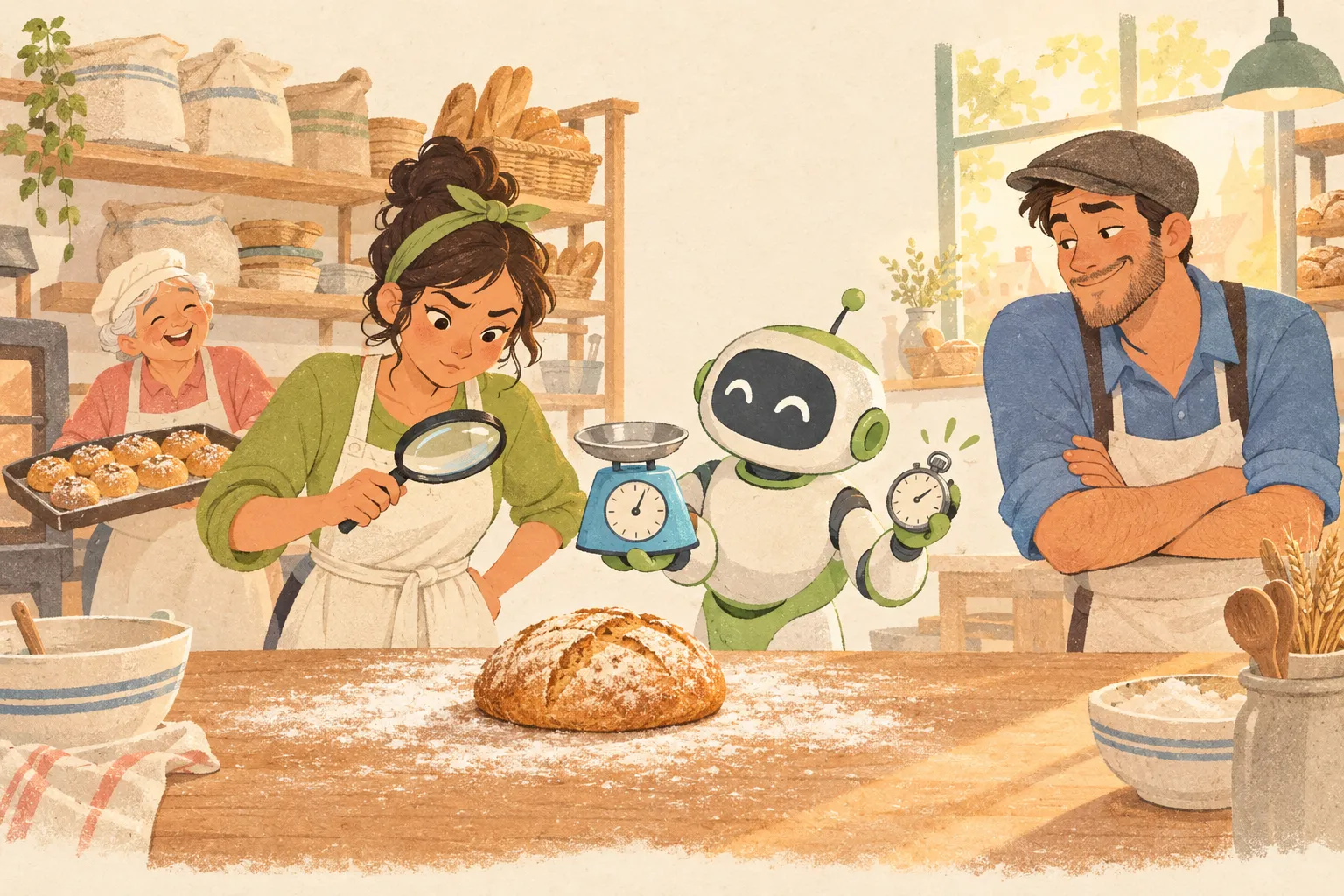
Ifeoma manages production at a small bakery with three shops. In September, the bakery switched to a new flour supplier, and in October, Tomasz, who runs the busiest shop, started saying the same thing at every Monday meeting: "Our bread goes stale faster since we changed flour."
Ifeoma asked how he knew. Tomasz shrugged. "I can tell. Prove me wrong."
So she tried. For a week she compared loaves, read the spec sheets and called the miller. Nothing showed a difference. Tomasz was unmoved: "That doesn't prove it's the same." He was right. It didn't. But it wasn't supposed to.
Tomasz made a claim and then handed Ifeoma the job of disproving it. That move has a name, the burden of proof fallacy. This guide covers who has to prove what, why "prove me wrong" doesn't work, how the rules change in court and debate, and what to say when someone hands you a burden that isn't yours.
What is the burden of proof?
The burden of proof is the duty to support a claim with evidence or reasons. The basic rule: whoever makes a claim carries the burden of supporting it. If you say the new flour makes bread go stale faster, it's on you to show it, not on everyone else to show it doesn't. The Latin name, still used by lawyers and philosophers, is onus probandi.
The burden of proof fallacy (also called shifting the burden of proof) is making a claim and then demanding that someone else disprove it. Bradley Dowden's entry on fallacies in the Internet Encyclopedia of Philosophy gives a simple example: someone says they saw a green alien from outer space, and when asked for proof, replies "You can't prove I didn't." That person, Dowden writes, is not accepting their burden of proof.
It is entry number 24 in our guide to logical fallacies, and it gets a short section in how to win an argument. This article goes further, because the hard part is the cases where it isn't obvious who the claimer is.
Burden of proof fallacy examples
You've heard most of these. Every one of them sounds like a challenge, and every one hands the work to the wrong person.
| Where | What they say | The claim they made | Who should be proving it |
|---|---|---|---|
| Work | "This vendor is overcharging us. Show me they're not." | The vendor overcharges | The person who said so |
| Health | "This supplement boosts memory. Prove it doesn't." | The supplement works | The person selling or recommending it |
| Online | "Prove the moon landing wasn't staged." | It was staged | The person claiming a hoax |
| Home | "The neighbors' kid scratched our car. Prove he didn't." | He did it | The person accusing him |
| Business | "Customers will love this feature. Prove they won't." | Customers will love it | The person proposing the feature |
None of these claims is necessarily false. The fallacy isn't in the claim. It's in the demand that the doubter do the claimer's homework.
Why "prove me wrong" doesn't work
The claimer knows what they mean. Tomasz knows what "stale faster" means to him: which loaves, how many hours, compared with what. Ifeoma has to guess. Every test she runs can be answered with "that's not what I meant," which quietly turns into moving the goalposts.
Negatives are usually much harder to show. To prove the new flour doesn't cause faster staling, Ifeoma would have to rule out every recipe, every oven, every shop and every day. To prove it does, Tomasz only needs one fair comparison.
Russell's teapot
The most famous illustration comes from the philosopher Bertrand Russell. In an essay called "Is There a God?", written in 1952 for Illustrated magazine (which never published it), he imagined someone claiming that a small china teapot orbits the sun between Earth and Mars, too small for any telescope to see. Nobody could disprove it, and that gives no one a reason to believe it.
You can hear the same idea in a line from the writer Christopher Hitchens, in his 2007 book God Is Not Great: "What can be asserted without evidence can also be dismissed without evidence." It's often called Hitchens's razor, and it echoes a much older Latin saying, quod gratis asseritur, gratis negatur: what is freely asserted is freely denied.
Can you prove a negative?
"You can't prove a negative" is too strong. You can prove plenty of negatives: there's no milk in the fridge, the meeting isn't on the calendar. What you can't do is prove a broad negative about a space you can't search, like "this flour never affects staling under any conditions." So the wider and vaguer the claim, the more unfair it is to demand that someone else disprove it.
Who carries the burden? Four rules of thumb
"Whoever makes the claim" covers most cases. When it doesn't, these four rules help.
1. The person who makes the claim
This is the default, and it includes claims dressed as questions: "Isn't it obvious the new manager is the problem?" is still a claim.
2. The side that wants change
In a group decision, the side asking for change usually carries the heavier load, because the current way is the default until someone shows a better one. Debate theorists call that default presumption. As a concept in argument, it is usually traced to the English archbishop Richard Whately, who wrote about presumption and burden of proof in Elements of Rhetoric (1828). Our guide on how to debate explains how this works in a formal round.
3. The bigger the claim, the bigger the burden
"I had toast for breakfast" needs no evidence. "I can predict lottery numbers" needs a lot. The astronomer Carl Sagan popularized the line "extraordinary claims require extraordinary evidence" (he used it in his 1979 book Broca's Brain). Quote Investigator traces the idea back much further, including to the mathematician Pierre-Simon Laplace, who wrote in the early 1800s that the more extraordinary a fact is, the stronger the proof it needs.
4. The higher the stakes, the higher the bar
If being wrong is cheap, a little evidence is enough. If being wrong is costly or dangerous, the person asking everyone to take the risk should show it's safe. "This bridge can carry the load" is a claim the builder must back up, not one the public has to disprove.
How the burden of proof works in court, debate and daily life
The idea is the same everywhere, but different settings set the bar at different heights.
| Setting | Who carries the burden | How high the bar is | What happens if it isn't met |
|---|---|---|---|
| Criminal trial (US) | The prosecution | Beyond a reasonable doubt | The defendant is acquitted |
| Civil lawsuit (US) | The plaintiff, in most cases | Preponderance of the evidence (more likely than not) | The plaintiff loses |
| Policy debate | The side proposing change (affirmative) | Enough to overcome presumption | The judge votes for the status quo |
| Science | Whoever proposes a new finding | Strong, repeatable evidence | The claim isn't accepted yet |
| Work decision | Whoever wants the change | Depends on cost and risk | Things stay as they are |
| Everyday argument | Whoever makes the claim | Depends on how bold the claim is | You don't have to accept it |
The legal standards come from the Legal Information Institute at Cornell Law School, which also lists a middle standard, clear and convincing evidence, used for issues such as fraud in disputes over wills. The lesson for everyday life: "proof" isn't one fixed thing. How much you need depends on what's at stake.
When "prove it's safe" is a fair demand
Here's the part most explanations skip. Sometimes demanding that the other side prove a negative is completely reasonable.
If a company wants to sell a new medicine, the public shouldn't have to prove it's harmful. The company should have to show it's safe and that it works. On the surface, the critics are the ones making a claim ("this might hurt people"), but the company is asking everyone to accept a new risk, so the burden is on them. The same goes for a colleague who wants to move all the company's files to a new system: they should show it won't lose data.
What makes this different from Tomasz's "prove me wrong"? The person asking for proof isn't making a bold claim of their own, only asking for a reasonable check. And the burden goes to the side that wants the change and the risk, which is rule 2 and rule 4 together.
| Fallacious shift | Fair demand |
|---|---|
| "I say it's true. Prove it isn't." | "You want us to accept a new risk. Show it's safe." |
| The claimer avoids doing any work | The person proposing the change does the work |
| The demand is unlimited ("prove it never happens") | The demand is specific ("show it passed these tests") |
| Absence of disproof is treated as support | Absence of proof is treated as a reason to wait |
Related fallacies and mistakes
The burden of proof shift has close relatives.
Appeal to ignorance. The Internet Encyclopedia of Philosophy describes it as treating "not knowing that a statement is false" as proof that it's true, or the reverse. "Nobody has shown the flour is fine, so it must be the problem" is one. The two often come together: first the burden is shifted, then the failure to carry it is treated as evidence.
Skeptics have burdens too. Asking for evidence is not a fallacy. But "that study is obviously rigged" is a claim, and it needs support like any other. Doubt is free; confident denial isn't.
Uneven standards. It's easy to demand proof for claims you dislike and wave through claims you like. Our guide to confirmation bias explains how that happens, even to careful people.
Worked example: Ifeoma and the stale bread
At the next Monday meeting, Ifeoma didn't call Tomasz's argument a fallacy. She took his worry seriously and handed it back in a form he could test.
"You might be right, and if you are, I want to know. Can we agree on what 'stale faster' means and test it properly? If the new flour is worse, we switch back."
They agreed on a plan Tomasz helped design, so he couldn't reject it later:
| Question | What they agreed |
|---|---|
| What exactly is the claim? | Sourdough loaves from the new flour go hard sooner than loaves from the old flour |
| How will we measure it? | Three staff squeeze-test and taste each loaf at 24 and 48 hours, without knowing which flour it is |
| What's a fair comparison? | Same recipe, same oven, same day, half the batch with leftover old flour |
| What would count as a difference? | Most testers rating the new-flour loaves staler at 48 hours on most days |
| What would change our minds? | Tomasz: no difference over two weeks. Ifeoma: a clear difference on most days |
After two weeks, the two flours came out about the same. But loaves from Tomasz's shop were staler than those from the other two, whichever flour they used. In September, the same month as the flour change, his shop had moved its bread display next to a new coffee machine. The warm, dry air was the likelier culprit.
Tomasz had noticed something real. He had just credited the wrong cause, a classic post hoc mistake. Putting the burden back on the claim didn't make him lose. It got him a fix.
How to respond when someone shifts the burden
"That's a burden of proof fallacy" is accurate and rarely helps; people dig in. Questions work better, because they invite the other person to do the work, which is the idea behind Socratic questioning.
A simple pattern: grant the possibility, return the claim, offer a test.
- Grant the possibility. "You might be right."
- Return the claim. "Since it's your point, what makes you think so?"
- Offer a test. "What would we expect to see if it's true? Let's look for that."
Here's how that sounds in common situations.
| What you hear | What you can say |
|---|---|
| "Prove me wrong." | "I can't, and I don't think I need to. What made you conclude it?" |
| "You can't prove it doesn't work." | "True. What's the best evidence that it does?" |
| "Show me they're not overcharging us." | "Happy to look. What did you see that made you think they are?" |
| "Nobody has disproved it." | "Nobody has disproved a lot of things. What has shown it's true?" |
| "Do your own research." | "I will. Which source convinced you? I'll start there." |
With someone you'll see again tomorrow, the third step matters most: testing the claim together turns a standoff into a shared project.
How to catch it in your own thinking
- Notice when you say "prove it isn't." That sentence almost always means you've made a claim you haven't supported yet.
- State your claim as a claim. "I think the new flour is worse" is honest. "Everyone knows the new flour is worse" hides the burden in "everyone."
- Size your claim to your evidence. If all you have is a feeling, say "I've noticed" instead of "it's a fact." Smaller claims carry smaller burdens.
- Write down what would change your mind. If you can't name anything, the problem isn't the other person's lack of proof.
How to practice this with AI
Your own claims feel like plain facts, so a burden you're dodging is hard to notice. A debate makes every claim visible as a claim. On Debatly, several AI models and characters argue different sides of your question over several rounds, you can step in at any point, and a judge gives a verdict with reasoning.
- Put your claim on trial. Type something you believe into the debate room as a question, like "Does our new flour make bread go stale faster?" Watch which side reaches for "you can't prove it doesn't."
- Ask a skeptic to assign the burden. Have Viktor, the skeptic, start by stating who is making the claim, what would count as support, and what would count against it. That first step settles many arguments before they start.
- Defend a proposal under pressure. In the pitch defense format, you present a change and the other side presses you to show it's worth it. Good practice for any meeting where you're asking for change.
- Read the verdict. Judge Alex explains which arguments carried the round. Check whether a side won because it actually supported its claim or because the other side simply failed to disprove it.
When Ifeoma ran the flour question as a debate, the side arguing against the new flour was asked in the first round what a fair test would look like. It suggested almost exactly the comparison she later ran.
An honest limit
AI models can't run your test or see your data. They can also shift the burden themselves, answering "there's no evidence it's harmful" as if that settled whether something is safe. And many models lean toward whatever you seem to believe already (see why AI agrees with you). Use the debate to sharpen the claim and design the test. The evidence still has to come from the real world.
Your claim, your evidence
The burden of proof isn't a debating trick. It decides who does the work, so arguments end with an answer instead of going in circles. Whoever makes the claim supports it, and the bigger and riskier the claim, the more evidence it needs.
This week, listen for "prove me wrong," including from yourself. When you hear it, hand the claim back gently and offer a test. If a claim matters to you, run it as a debate on Debatly and let a skeptic decide who has to prove what. Give it a try. Plans are on the pricing page.
“Burden of Proof: Who Has to Prove What in an Argument”