You are in a meeting and someone proposes moving the product launch up by a month. You think it is a bad idea. You say so, they push back, your voice rises a little, and five minutes later the room has agreed with whoever sounded most confident. On the way back to your desk you think of the perfect counterpoint. Too late.
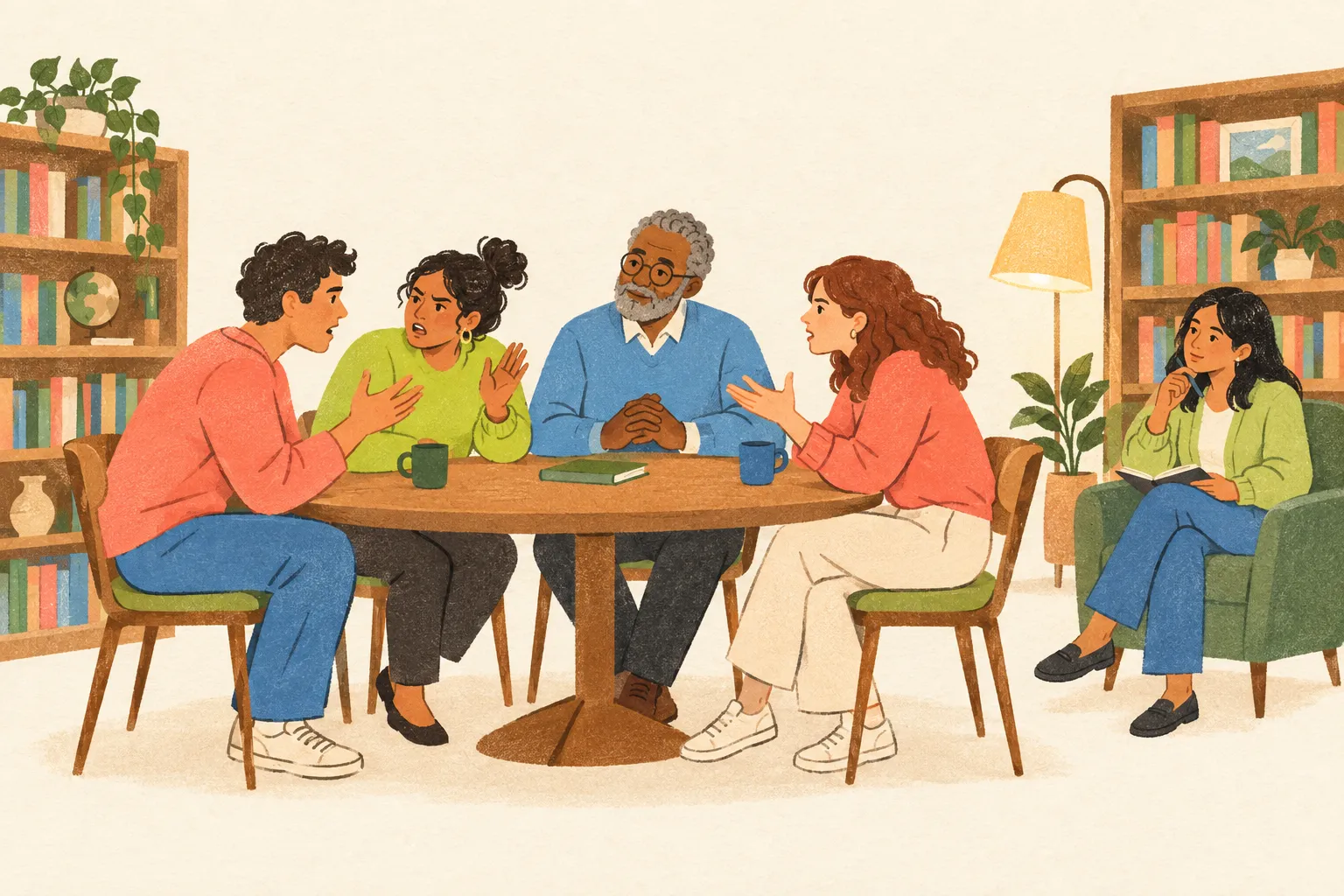
Or it is Sunday dinner, and your uncle has an opinion about electric cars. Twenty minutes later nobody has changed their mind, two people are annoyed, and the potatoes are cold.
Both situations fail for the same reason: nobody was actually debating. They were trading assertions. Debate is a skill with a few mechanics that make a huge difference once you know them: how to prepare, how to build an argument that survives an attack, how to answer the other side, and how to explain why your point matters more than theirs.
This guide covers all of it, for students heading into their first tournament, professionals who want to win arguments at work without burning bridges, and anyone who wants their next disagreement to end with clearer thinking. There is a fully worked example in the middle and a practice plan at the end.
What a good debate is
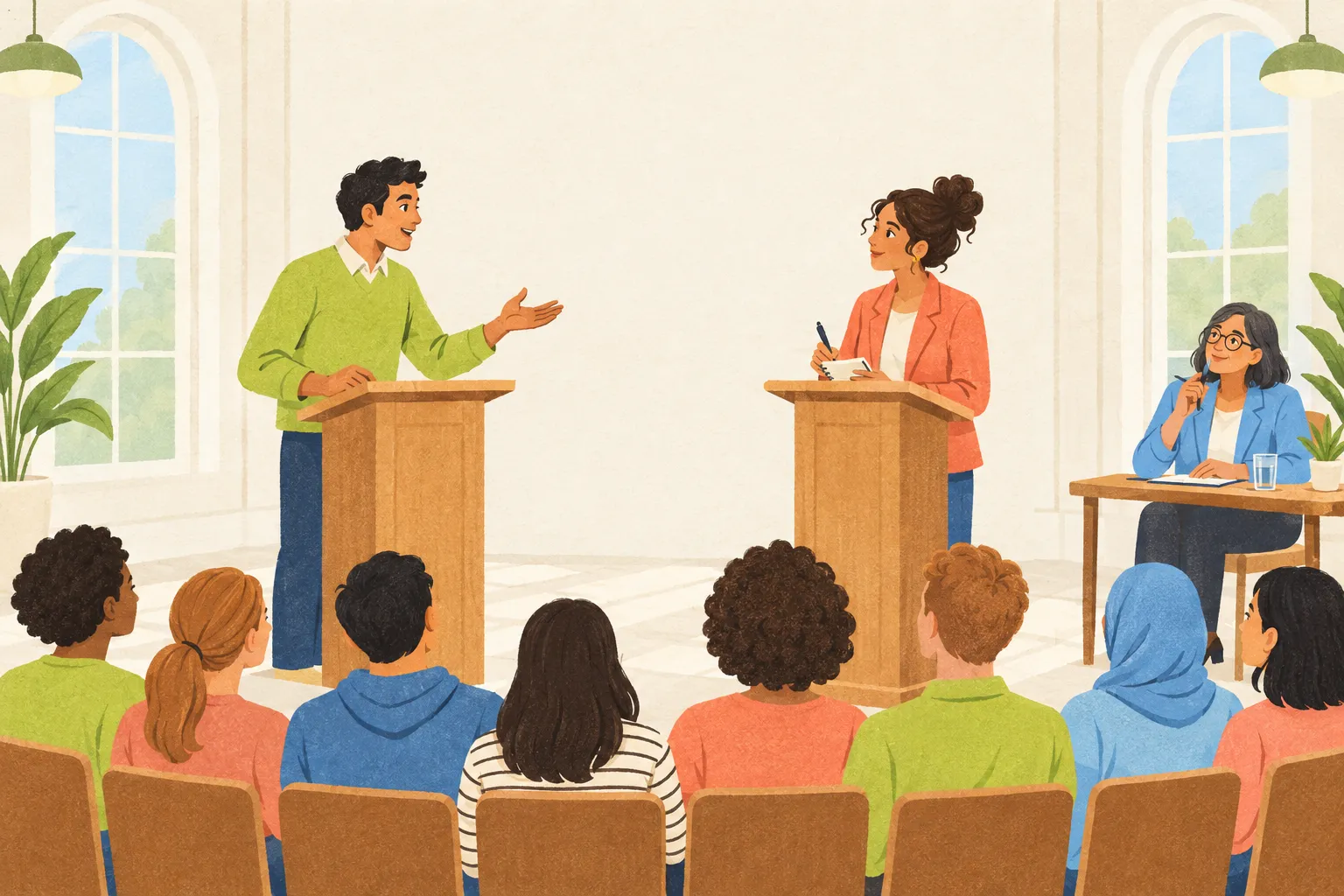
A debate is a structured disagreement where both sides try to persuade a third party, or each other, using reasons. A fight is a disagreement where both sides try to win status. The words can look similar. The goals are completely different.
In a good debate:
- Both sides agree on what is being argued. There is a clear question, often called the motion or resolution.
- Claims come with reasons. "Because I said so" and "everyone knows" do not count.
- Each side responds to what the other actually said, not to a weaker version of it.
- Someone decides. A judge, an audience, a manager, or the two of you agreeing on criteria in advance.
"Winning fairly" means persuading on the merits. You can be ruthless with an argument while staying respectful to the person making it. The best debaters are often the calmest people in the room, because they are not defending their ego. They are defending a position, and they know exactly why it holds. And a good debate can end with you changing your mind. That is not losing. That is the process working.
Prepare before you argue
Most debates are won or lost before anyone speaks. Even ten focused minutes beats walking in with a gut feeling.
Research both sides
Write down the three strongest arguments for your side and the three strongest against it. If you cannot name the opposition's best points, you are not ready, because they will. Competitive debaters often learn their side shortly before the round, so they prepare both. That habit is worth stealing even when your side is fixed.
Define your terms
Many arguments are disputes about definitions in disguise. "Should we ban phones in schools?" Does "ban" mean confiscated at the gate, or switched off during class? Agree on definitions early, or state yours clearly in your opening. If the other side uses a slippery definition, calling it out is often the fastest way to win the point.
Know who carries the burden of proof
The side that wants to change something usually has to prove the change is worth it. If you propose a four-day work week, you need to show benefits that outweigh the costs. If you defend the status quo, you only need to show that the case for change is not strong enough. Knowing where the burden sits tells you how much you actually have to prove.
Quick prep checklist
- Write the motion as one clear sentence.
- Define the two or three key words in it.
- List your top three arguments and their top three.
- Find one piece of evidence for each of your arguments.
- Lead with your strongest argument.
Want to practice the definitions part? Try a question where the whole fight is about what a word means:
Build an argument that holds
An argument is not a sentence. It is a small machine with moving parts, and once you can see the parts, you can build stronger ones and break the other side's.
ARE and AREI
The simplest model, taught in many school debate programs, is ARE: Assertion, Reasoning, Evidence. Many coaches add an I for Impact.
- Assertion: what you claim. "Homework in primary schools should be banned."
- Reasoning: why it is true. "Young children learn best through play and rest, and homework takes time from both."
- Evidence: an example, a study you can actually name, expert testimony, or a clear logical case.
- Impact: why it matters. "Kids who are resentful of learning by age nine are less likely to enjoy it later."
Most weak arguments stop at the assertion. Impact is what turns a correct point into a winning one, because it tells the judge why they should care.
The Toulmin model
Philosopher Stephen Toulmin broke arguments into six parts. The three you will use most are the claim (the conclusion you want accepted), the grounds (the facts you offer) and the warrant (the bridge explaining why those facts support that claim).
The warrant is the part people skip, and it is where arguments break. "Crime went up after the new mayor took office, so the mayor caused it." The grounds might be true. The warrant (anything that happens after a person arrives is caused by that person) is obviously weak once you say it out loud. Toulmin also adds backing, qualifiers ("usually", "in most cases") and rebuttals (conditions where the claim fails). A qualifier makes you harder to attack, not weaker.
A useful habit: after every claim you make, ask yourself "why does that follow?" If you cannot say the warrant in one sentence, your opponent will find the gap for you.
If you are stuck generating arguments, the AI argument generator can give you a starting list for both sides. Treat it as raw material, then run each point through ARE yourself.
Structure and deliver your speech
A clear structure makes you sound twice as prepared as you are. Whether you have two minutes in a meeting or seven in a tournament, the same skeleton works.
The four-part skeleton
- Opening. State the motion, your side, your key definitions and a roadmap: "I will make two arguments, then answer what we just heard."
- Your arguments (the bulk of your time). Two or three, never more, each with a label, reasoning, evidence and impact. "My first argument is about time. My second is about fairness."
- Rebuttal. Answer the other side's strongest points. If you speak first, preempt what they are likely to say.
- Summary. Remind the audience of the one or two reasons your side wins. No new arguments here.
Three strong arguments beat six mediocre ones. Every extra point dilutes your time and gives the opponent another target.
Ethos, pathos, logos
Aristotle's three modes of persuasion still hold up. Logos is the logic of your case: structure, sound warrants, real evidence. Ethos is credibility, earned by being fair to the other side, admitting what you do not know and getting facts right. Pathos is emotion: a short, concrete story about one real person lands harder than a pile of abstractions. Use all three, with logos doing most of the work. Pathos without logos feels manipulative. Logos without pathos feels like a spreadsheet.
On delivery: slow down, because nerves speed everyone up. Pause after key sentences. Keep your voice calmest when you disagree most. Signpost constantly ("that is my first point, now my second"). And use bullet notes, not a script, so you look at people instead of paper.
Rebuttal and weighing
Rebuttal is where debates are actually decided. Anyone can prepare a speech. Answering an argument you heard ninety seconds ago is the real skill.
Four ways to answer an argument
- Deny the evidence. "That figure is from a single school." Useful, but the weakest option, since they can often find more evidence.
- Attack the warrant. "Even if that is true, it does not follow that..." Usually the strongest move, because it breaks the link between their facts and their conclusion.
- Mitigate. "That happens, but rarely, and the effect is small."
- Turn it. Show that their argument actually supports your side. A good turn is the most satisfying move in debate, because the other side's work now counts for you.
Weighing: why your point matters more
Often both sides have true points, and the debate comes down to which matter more. If you do not tell the judge how to weigh, they will decide on their own, which is a gamble. Compare impacts on three axes:
| Axis | Question to ask | Example |
|---|---|---|
| Magnitude | How big is the effect? | Every student vs a few |
| Probability | How likely is it? | Near certain vs a speculative chain |
| Timeframe | How soon, and for how long? | Starts tomorrow vs maybe in ten years |
You can also weigh on reversibility (can the harm be undone?) and who is affected. The sentence to practice is: "Even if they are right about X, our point about Y matters more, because..." It wins more rounds than any clever line.
Questions and fallacies
Asking good questions
Many formats include cross-examination, and in everyday arguments questions are often more persuasive than statements. Good questions are short and closed ("Does your plan apply to children under eight?"), set up a later argument (get the concession now, use it next speech) and clarify before attacking ("So your claim is that X causes Y?"). Never ask a question you would hate the answer to, and do not use questioning time to make speeches.
The Socratic method is questioning at its purest: step by step, the contradictions in a position surface on their own. To feel how that works from the receiving end, try a Socratic method AI session with Socrates.
Common logical fallacies
Knowing fallacies helps you spot broken reasoning, including your own:
- Ad hominem: attacking the person. "You would say that, you do not even have kids."
- Straw man: answering a weaker version. "So you want children to learn nothing at home?"
- False dilemma: "Either we ban homework or we keep the current load."
- Slippery slope: "Ban homework and soon they will ban exams."
- Appeal to authority: "A famous CEO said it, so it is true."
- Post hoc: "Grades dropped after the new policy, so the policy caused it."
- Hasty generalization: "My nephew hated homework, so all kids do."
Just do not become the fallacy police. Shouting "straw man!" wins nothing and makes you look pedantic. Explain the damage instead: "My opponent answered a position I did not take. What I actually said was X, and that point still stands."
Want to feel what it is like when someone asks instead of argues?
A worked example
Here is one motion from start to finish, compressed, so you can see every part in action.
Motion: This house would ban homework in primary schools. The proposition defines "primary" as ages 5 to 11 and "ban" as no required work at home; optional reading stays.
The proposition opening (Jonah)
"I have two arguments: time and fairness.
First, time. A seven-year-old's afternoon is short. Play, sleep, family time and simply being bored are how young children build curiosity and social skills. Every half hour of worksheets comes out of that. The impact is kids who associate learning with chores before they can see its value.
Second, fairness. Homework assumes a quiet table and an adult who can help. Some kids have both. Some have a parent working evenings and three siblings in one room. Homework does not measure what a child learned. It measures what a child's home can provide, and the gap grows every evening."
Definitions, roadmap, two labeled arguments, each with reasoning and impact.
The opposition rebuttal (Keiko)
"On time: the warrant is that homework replaces play. But most primary homework is fifteen to twenty minutes. The problem Jonah describes is too much homework, and the fix for too much is less, not zero.
On fairness, I want to turn the argument. Yes, homes differ. But a ban does not remove that gap. Wealthier families will simply buy tutors and workbooks. Structured homework, supported by school homework clubs, is the one thing that gives every child the same practice. Ban it, and the gap gets wider.
And one argument of our own: habits. Short, regular practice at home builds the routine children need in secondary school. Starting at twelve, with much heavier work, is a harder landing."
Keiko mitigated the first point, turned the second, and added a constructive argument.
The weighing summary (Jonah)
"Two clashes decided this debate.
On fairness, my opponent says families will buy tutors anyway. Even if that is true, it happens with or without homework. What homework adds is a nightly task that marks down the kids without help. Our harm hits many children, every evening, starting now. Their benefit depends on homework clubs many schools do not have. On probability and timeframe, we win.
On habits, they offer a benefit at twelve. We offer one at seven, eight and nine, every day. A child who still likes learning at eleven builds routines far more easily than one who learned to dread it. Weigh certainty against speculation, and today against someday."
A judge could still vote either way, and that is the point: both sides clashed directly, and the summary told the judge exactly how to decide. Run this motion on Debatly and see how Judge Alex weighs it.
Debating at work and at home
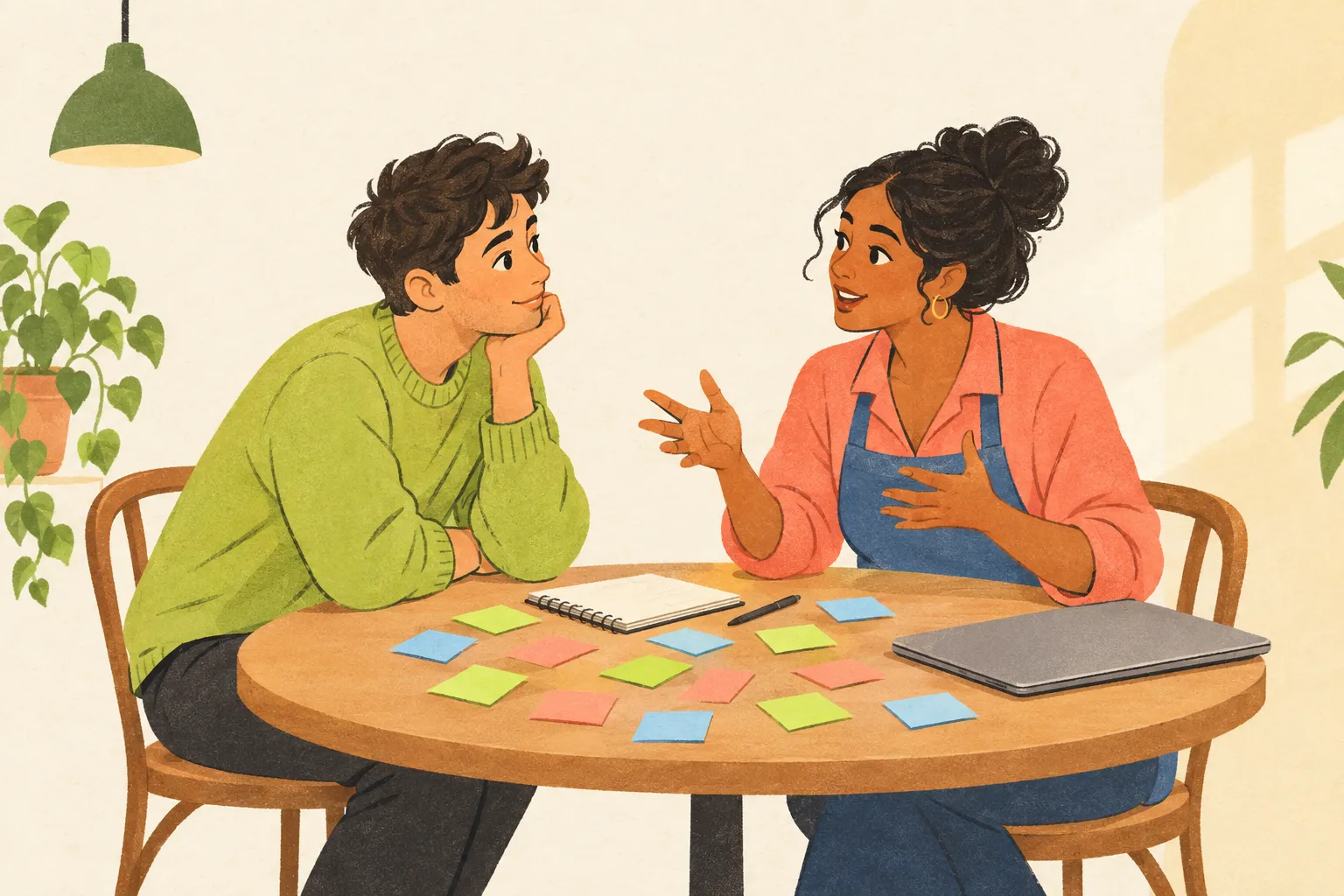
Most of your debates will have no timer and no judge. They happen in meetings and at kitchen tables, with people you will see again tomorrow. The mechanics are the same, but the goal shifts from winning to reaching a better answer together.
Steelman before you argue
A steelman is the opposite of a straw man: you restate the other person's position in its strongest form. "So your concern is that launching early means support gets overwhelmed while we are still fixing bugs, and that could cost us the first customers' trust. Is that fair?" When they say yes, they feel heard, and you are now arguing against their real point. Daniel Dennett popularized a version of this rule: restate, note agreement, mention what you learned, and only then criticize.
Disagree without damage
- Separate the idea from the person. "This plan has a timing problem," not "you are rushing this."
- Agree on criteria first. "What matters most here: speed, cost or quality?" Many workplace arguments are really about priorities.
- Concede good points out loud. It makes your other points more credible.
- Offer a test. "Could we pilot it with one team first?" often ends a stalemate.
Ben thinks his manager, Carla, is wrong to require three office days a week. Instead of "this policy is pointless," he says: "I understand the goal is better collaboration, and I agree onboarding suffered last year. My concern is that fixed days mean people commute to sit on video calls. Could we pick days by team?" Same disagreement, much better odds.
For choices where the debate is inside your own head, how to make better decisions with AI pairs well with everything here. To rehearse a tough conversation with money on the line, try AI negotiation practice.
Try one that tends to split every office:
Formats and how to practice
Popular debate formats
| Format | Teams | Style | Good for |
|---|---|---|---|
| Oxford style | Two sides, audience vote | Formal speeches, audience polled before and after | Persuading a crowd |
| Lincoln-Douglas | One vs one | Values and philosophy, cross-examination | Ethical reasoning |
| British Parliamentary | Four teams of two | Short prep, fast rebuttal | Thinking on your feet |
| Public Forum | Two teams of two | Current events, plain language | Beginners |
Drills that work
- Switch sides. Prepare a motion, then argue the opposite. The best single exercise for seeing the whole issue.
- One-minute rebuttals. Have someone read an argument, then answer it in sixty seconds by attacking the warrant.
- Weighing sentences. Take any two impacts and practice "even if X, Y matters more because..." until it is automatic.
- Record yourself. Watch once for content, once for delivery. You will catch filler words you never hear live.
Practice against AI debaters
The hardest part of practice is finding a partner who will argue about homework policy at 10 p.m. An AI debate tool fills that gap. On Debatly, several AI models take opposing sides of your question across rounds, and a judge weighs the arguments and gives a verdict with reasoning. If the concept is new, what an AI debate room is explains how a session runs.
Three formats map neatly onto this guide:
- For vs Against is classic debate. Enter a motion, watch both sides build and rebut, then check whether the judge weighed it the way you would.
- Devil's Advocate puts one character on the attack against your position. Petra, the devil's advocate finds the weakest link in your case, and Viktor, the skeptic challenges every piece of evidence.
- Socratic gives you a questioner instead of an opponent, the best drill for finding missing warrants.
For something playful, the scenes page includes "The Great Debate", a roleplay scenario where you argue a case in character. The debate room is where you run your own motions, and if you are new to prompting AI, see how to chat with AI.
An honest limit: AI debaters are great sparring partners, but they do not replace a coach or a real audience. Use them for volume and variety, then test yourself with people.
Start your first practice round
You now have the toolkit: prepare both sides, define your terms, build arguments with a warrant and an impact, rebut by attacking the warrant or turning the point, and always tell the judge how to weigh. Pick one motion this week, argue both sides, and record your summary.
If you want a sparring partner who is always ready, open a For vs Against debate on Debatly and see how the judge scores it. Try for free, and bring your toughest motion.
“How to Debate: A Practical Guide to Arguing Well (and Winning Fairly)”