Wairimu and her husband Otieno are choosing a primary school for their daughter in Nairobi. They have it down to two. On Saturday they visit the one Otieno loves, and they come home with a glossy brochure.
It's impressive. There's a photo of three former pupils who got top national exam marks. There are four warm quotes from parents. There's a bar chart of exam results that climbs steadily, year after year.
That evening Otieno forwards her a stack of messages from the school's parent group. Every one is glowing. "See?" he says. "Everyone is happy there."
Wairimu reads it all and can't point to anything false. Then she notices what's missing. How did the rest of the class do, not just the top three? Why does the chart start in 2021? And Otieno's sister has a son at that school. Why didn't he forward any of her messages?
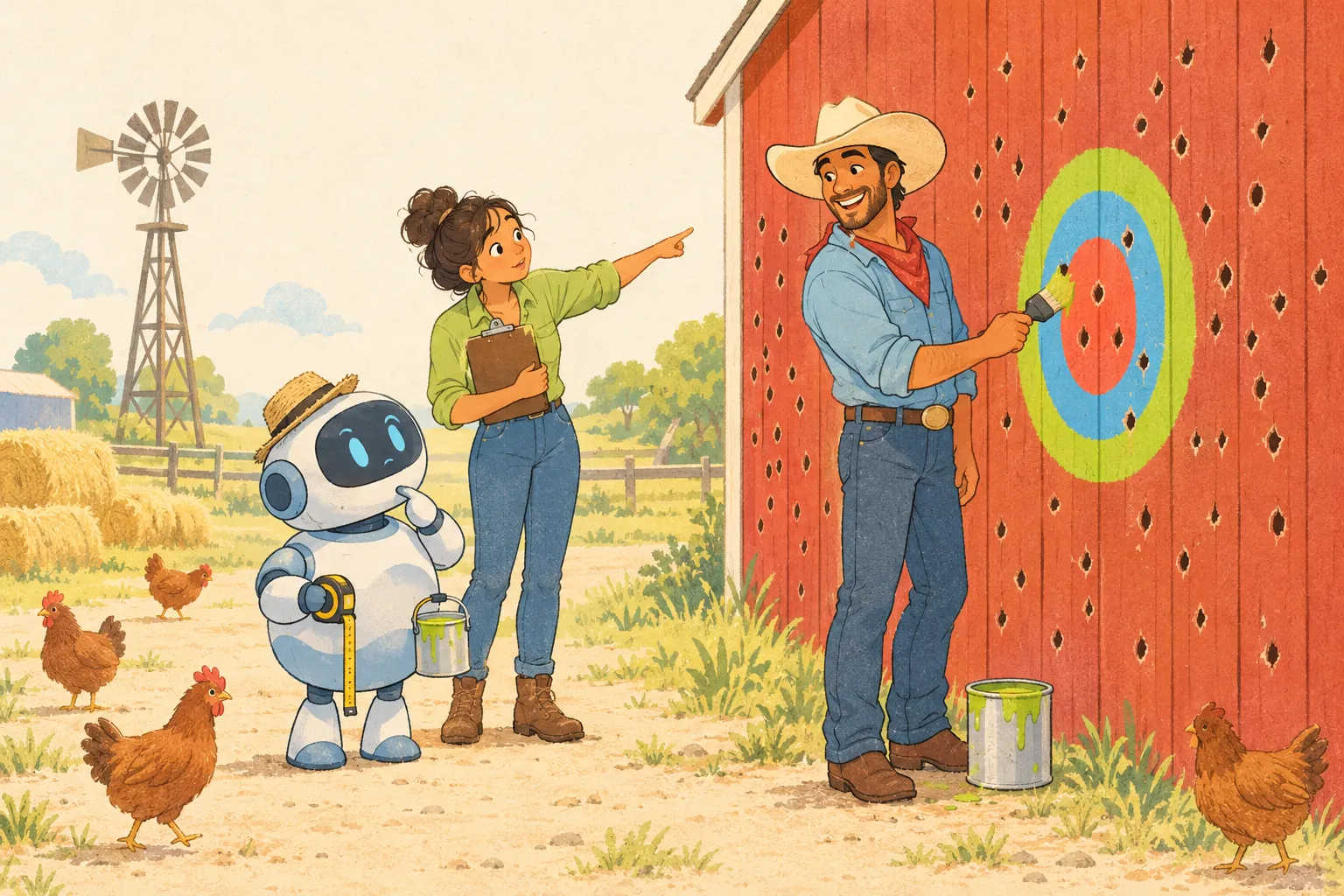
Nobody here is lying. They're showing the ripest fruit. That move has a name: the cherry picking fallacy. This guide covers what it is, the forms it takes, when leaving things out is perfectly fair, and five questions that bring the missing evidence back.
What is the cherry picking fallacy?
The cherry picking fallacy is supporting a claim with the evidence that fits it while leaving out relevant evidence that points the other way. Each piece shown may be true. The overall picture is false because of what's missing.
It goes by several other names: suppressed evidence, the fallacy of incomplete evidence, a one-sided argument, and card stacking, after the magician's trick of stacking the deck.
The name comes from fruit picking. A picker chooses only the ripest, healthiest cherries. Anyone who sees just the basket might conclude that the whole tree looks like that.
Three features give it away:
- There's a bigger pile. The evidence shown was picked from a larger set of results, cases, quotes or years.
- The pick isn't typical. What's shown is better (or worse) than the full set.
- What's missing would change the conclusion. If the rest of the pile were on the table, the claim would look weaker.
Cherry picking is entry 19 in our guide to logical fallacies. This article goes deeper, because the hardest cherry picking to catch is the kind nobody meant to do.
When leaving something out is not cherry picking
Here's what most explanations skip. Every summary leaves things out. A brochure can't list every pupil's results, and a two-minute pitch can't cover every study. Selecting isn't the fallacy.
The fallacy is leaving out evidence that is both relevant and significant: the kind that would change what a reasonable person concludes. A school that shows its best art projects isn't misleading anyone, because nobody thinks every child paints like that. A school that shows its three best exam results while implying they're typical is.
Intent doesn't decide it either. Cherry picking can be deliberate, like a sales pitch built to persuade. More often it's accidental. Otieno didn't hide his sister's messages on purpose. He forwarded the ones he remembered, and he remembered the ones that agreed with him. That's confirmation bias turning into an argument.
So the useful question is never "did they leave something out?" It's "would the missing part change my mind?"
The common forms of cherry picking
Cherry picking wears many outfits. Once you know them, you'll spot them in ads, meetings and group chats.
| Form | What it looks like | The question that catches it |
|---|---|---|
| Best results only | "Three of our pupils got top marks." | "How did everyone else do?" |
| Chosen time window | A chart that starts in the worst year, so everything after looks like growth | "What does it look like over a longer period?" |
| Quote mining | A sentence lifted from a review, a study or a speech, leaving out the "but" that followed | "What did the full quote say?" |
| One study among many | "A study found..." when several others found the opposite | "What do the other studies say?" |
| Hand-picked anecdotes | A few vivid stories standing in for the whole group | "Are these typical, or the most memorable?" |
| Missing denominator | "Fifty customers switched to us this month!" | "Out of how many who tried you?" |
| Favorable subgroup | "Among users over 40, satisfaction rose 20%." | "And among everyone else?" |
| Filtered reviews | Only five star reviews shown on the page | "Where are the others?" |
Quote mining is the easiest to do by accident. A reviewer writes, "The first chapter is brilliant, but the rest of the book falls apart." Print "brilliant" on the cover and every word you quoted is real.
Cherry picking examples from everyday life
You've met most of these this month. In each one, the evidence shown is real. It's the selection that misleads.
| Where | What you see | What's left out |
|---|---|---|
| School brochure | Top three exam results and four happy parents | The average results, and parents who moved their kids out |
| Fitness ad | Three dramatic before and after photos | Everyone who followed the plan and saw little change |
| Investment pitch | Returns from the fund's best five years | The years it lost money, or funds that closed |
| Family argument | "You always forget my birthday: 2019, 2022!" | The other five years you remembered |
| Product launch | Five glowing customer quotes on a slide | The support tickets and cancellations |
| Online debate | One study that agrees, posted with total confidence | The larger body of research that doesn't |
The family example shows how personal this gets. Two forgotten birthdays are real. Picking them and calling it "always" is cherry picking (and a hasty generalization on top).
When nobody picks the cherries: published research
Cherry picking doesn't need a villain. Sometimes a whole system does the picking, and the result is the same: the evidence you can see isn't the evidence that exists.
Medical research has a famous case. In 2008, Turner and colleagues published a study in the New England Journal of Medicine comparing what the US Food and Drug Administration knew about antidepressant trials with what appeared in medical journals. They looked at 74 FDA-registered studies of 12 antidepressants, involving 12,564 patients. Of those studies, 31% were never published.
The gap mattered. According to the published literature, 94% of the trials were positive. The FDA's analysis showed that 51% were. Studies the FDA saw as negative or questionable were mostly either not published or, in the authors' view, published in a way that conveyed a positive outcome. Across the drugs, the published data made the effect look 32% larger overall. The authors noted they couldn't tell whether the cause was authors and sponsors not submitting the studies, journals not accepting them, or both.
A 2010 review in the BMJ by Eyding and colleagues found something similar for one antidepressant, reboxetine. Across 13 trials with 4,098 patients, data on 74% of the patients had never been published. The published data overestimated the drug's benefit compared with placebo by up to 115%, and underestimated its harms. With the full data, the authors concluded it was "overall, an ineffective and potentially harmful antidepressant."
The lesson for the rest of us: when you can only see the studies that got published, the reviews that got displayed, or the stories that got shared, ask what filtered them. The survivorship bias guide covers the same trap from a different angle: the evidence that didn't survive to reach you.
Filtered reviews: cherry picking you can shop past
Star ratings are a cherry picking problem waiting to happen. If a business can hide its bad reviews, the average on the page tells you only what the business wanted you to see.
In the United States, regulators have treated this as deceptive. In August 2024, the Federal Trade Commission announced a final rule on fake reviews that, among other things, bars a business from misrepresenting that the reviews on its website represent all or most of the reviews submitted when reviews have been suppressed based on their ratings or negative sentiment.
Either way, protect yourself: read reviews on a site the seller doesn't control and sort by lowest rating first.
Cherry picking vs related mistakes
Cherry picking travels with a crowd of similar errors. Telling them apart helps you ask the right question.
| Mistake | What happens | The question that catches it |
|---|---|---|
| Cherry picking | Supporting evidence is shown, relevant counter-evidence is left out | "Can we see all of it?" |
| Texas sharpshooter | A pattern is found in the results, then presented as if it were predicted | "Was this what we were looking for before we looked?" |
| Confirmation bias | You notice and remember what fits your belief | "What would I see if I were wrong?" |
| Hasty generalization | A broad rule from too few cases | "How many cases is this based on?" |
| Survivorship bias | Only the cases that made it through are visible | "Who is missing from this picture?" |
| Quote mining | Words lifted out of context to reverse their meaning | "What did they actually say in full?" |
A cherry picker has the conclusion first and goes looking for support. A sharpshooter has the data first and draws the conclusion around a lucky cluster. The same fix works for both: look at the whole tree.
How to spot it: five questions
You don't need to be a statistician. These five questions catch most cherry picking.
1. What's the full set?
"How many results, reviews, studies or years were there in total?" Three great exam results out of 20 pupils is one story. Three out of 200 is another.
2. Who did the choosing?
The person who picks the evidence usually has a reason to pick it. A school brochure, a sales deck and your own memory all choose favorites. That doesn't make them wrong. It means the selection needs checking.
3. Why this window?
Charts, rankings and success stories all start and stop somewhere. Ask why the chart starts where it does. If moving the start date by a year or two changes the story, the window was doing the arguing.
4. What would the other side show you?
Imagine someone who disagrees had five minutes to add evidence. What would they bring? If you can name it easily and it isn't there, you've found the gap.
5. Would the missing part change the conclusion?
This is the test that separates fair summary from fallacy. If the rest of the pile would only confirm the picture, the selection is fine. If it would weaken it, ask to see it.
How to catch it in your own thinking
You cherry pick too. Everyone does, mostly by remembering the evidence that agrees with them. A few habits help.
- Collect before you conclude. When you research a decision, write down everything you find, for and against, before you decide which way you lean.
- Search for the opposite on purpose. Look up "problems with" or "criticism of" the thing you like. If you can't find any, you probably haven't looked hard enough.
- Show your denominator. When you share a win, say out of how many. "Two of the five vendors we tested" earns more trust than "two vendors."
- Make the best case against yourself. Steelmanning the other side forces you to go and find the evidence you've been skipping.
How to respond without starting a fight
"You're cherry picking" sounds like an accusation of cheating. Most cherry pickers don't know they're doing it, so be curious about the missing evidence, not suspicious.
A simple pattern: credit what they showed, ask for the rest, offer to look together.
| What you hear | What you can say |
|---|---|
| "Look at these amazing reviews!" | "They're great. Can we look at the low ones too, so we know what the worst case is?" |
| "A study proved it works." | "Interesting. Do you know if other studies found the same thing?" |
| "Sales are up 40% since March!" | "Nice. What did they look like over the last two years?" |
| "You always do this. Remember last June?" | "I remember June. Can we talk about how often it really happens?" |
| "Everyone in the group loves this school." | "That's good to hear. Have you heard from anyone who left?" |
With people you care about, the last step matters most. "Let's look at the rest together" lets them be right for a better reason, or change their mind without losing face.
Worked example: Wairimu's school decision
Wairimu didn't tell Otieno he was cherry picking. She said, "I like it too. Before we decide, can we look at the same things for both schools?"
They ran the five questions together:
| Question | What they found |
|---|---|
| What's the full set? | The school's results page listed average marks for the whole class. They were good, but close to the other school's. |
| Who did the choosing? | The brochure came from the school, and the messages came from Otieno's memory. Both had favorites. |
| Why this window? | The chart started in 2021. In 2019 and 2020 the results had been higher, then dropped. |
| What would the other side show? | Otieno's sister, when they called her, liked the teachers but said class sizes had grown a lot. |
| Would the missing part change the conclusion? | Partly. The school was still a good option, but no longer the obvious winner. |
They visited the second school with the same list of questions and asked both for the same numbers. In the end they chose the second school, mostly because of class size. Otieno was fine with it. "I wasn't wrong about the teachers," he said. "I just hadn't asked about anything else."
How to practice this with AI
Cherry picking is hard to catch when you're the one holding the basket. A structured debate helps, because the other side's whole job is to bring the evidence you left out. On Debatly, several AI models and characters argue different sides of your question over several rounds, you can step in at any point, and a judge gives a verdict with reasoning.
- Put your evidence on trial. Type your decision into the debate room with the evidence you've gathered, for example "Should we choose this school, given its top exam results and happy parents?" Ask one side to argue against it and see what it says is missing.
- Ask a skeptic for the rest of the tree. Viktor, the skeptic, will ask about denominators, time windows and the reviews you didn't read.
- Argue against your favorite. Petra, the devil's advocate, will build the strongest case against the option you like, which is exactly the evidence you're least likely to go looking for.
- Read the verdict, then the reasoning. Judge Alex explains which arguments carried the round. Check whether the winning side relied on the full picture or on a few striking examples.
An honest limit
An AI can't see the evidence you didn't give it. It doesn't know your school's full results, your company's real numbers, or the studies that were never published. It can also produce a confident list of supporting points for almost any position, which is cherry picking at machine speed. And many models lean toward whatever you seem to believe already (see why AI agrees with you). Use a debate to find out which questions to ask and what evidence to request. The answers still have to come from the full set.
Ask for the whole tree
The cherry picking fallacy wins by showing you real evidence and letting you assume it's typical. The fix is a habit: ask what the full set looks like, who chose what you're seeing, and whether the missing part would change your mind.
This week, when someone shows you an impressive result, ask one question: "Out of how many?" And when you're about to make a decision you care about, run it as a debate on Debatly and let the other side bring the cherries you left on the tree. Give it a try. Plans are on the pricing page.
“Cherry Picking Fallacy: Examples and How to Ask for the Whole Picture”