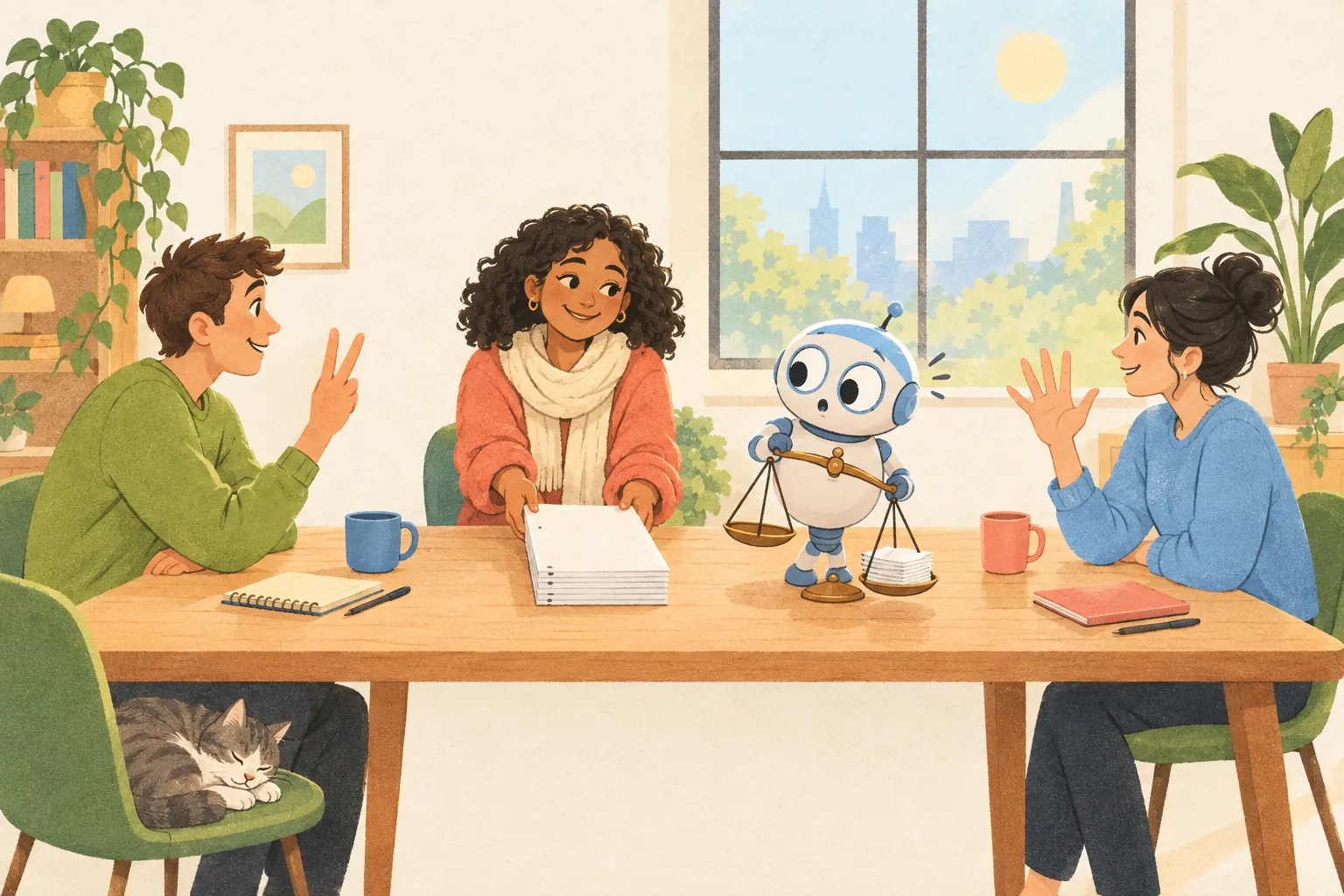
Nasrin leads client projects at a small design agency in Toronto. In Thursday's meeting, two colleagues are arguing about a client who wants a seventh round of changes to their new logo.
Kwabena, who handles the account, is sure the contract includes two revision rounds. Elena, the lead designer, remembers that it says unlimited revisions within the first month. Both are confident. Both are getting louder.
The agency owner sighs. "Look, you're both partly right. Let's just tell the client they get four rounds and move on."
It sounds fair. Everyone gets something. But Nasrin notices the problem: the contract says one thing. It doesn't say four just because four is between two and unlimited. Somewhere in the shared drive there's a signed PDF with the answer, and the compromise ignores it.
That move has a name: the middle ground fallacy. This guide covers what it is, why it's so tempting, when the middle really is the right answer, and four questions that tell you which situation you're in.
What is the middle ground fallacy?
The middle ground fallacy is assuming that the truth or the best solution must lie halfway between two opposing positions, simply because it's in the middle. It's also called the argument to moderation, false compromise, golden mean fallacy, fallacy of gray, or in Latin argumentum ad temperantiam.
The textbook example: one person says the daytime sky is blue, another says it's yellow. The middle ground fallacy concludes the sky must be green, because green sits between them. Of course, one person was simply right.
Compromise isn't the fallacy. Plenty of good answers sit in the middle. The mistake is treating "it's in the middle" as the reason an answer is correct.
It's entry 25 in our guide to logical fallacies, and it's the mirror image of the false dilemma. A false dilemma hides the options in between. The middle ground fallacy assumes the answer must be one of them.
Why splitting the difference feels so right
Nobody falls for this because they're careless. The middle is attractive for good reasons.
- It feels fair. Each side gives a little, nobody loses face, and the meeting can end. That's a real benefit, and it's often why people suggest it.
- It looks humble. "The truth is probably somewhere in between" sounds wise and open minded. Sometimes it is.
- It avoids picking a winner. If you choose a side, you might be wrong, and someone will be annoyed with you. The middle spreads the risk.
- It often works. Where to eat, what temperature to set, how to split a chore. The middle is often right there, so we learn the habit and then use it everywhere.
Splitting the difference is a great tool for some disagreements and a bad one for others. The skill is telling them apart.
When the middle is right, and when it's just a guess
The most useful question is: what kind of disagreement is this?
| Kind of disagreement | Example | Is the middle a good answer? | Better move |
|---|---|---|---|
| A fact that can be checked | "The contract says two rounds" vs "unlimited" | No. One version is in the document | Look it up |
| A preference | Pizza or sushi for the team lunch | Often yes, or take turns | Compromise freely |
| A trade-off between real costs | Bigger marketing budget vs more savings | Often yes, if both concerns are valid | Weigh both sides, then pick a point |
| A yes or no choice | Ship the feature this week or not | There may be no middle at all | Decide, or find a real third option |
| A safety or ethical limit | "The ladder holds 100 kg" vs "it holds 200 kg" | No. Guessing in between is dangerous | Check the rating, stay under the lower one until you know |
| A negotiation over a price | Buyer offers 300, seller asks 500 | Sometimes, but watch the starting points | Decide your own target first |
Facts, limits and yes or no choices are where the fallacy does damage. Preferences and trade-offs are where compromise shines. Nasrin's meeting was a fact dressed up as a preference.
Middle ground fallacy examples
You'll find it everywhere once you look for it. In each of these, the middle is chosen for being the middle, not for being supported.
| Where | The two positions | The "compromise" | What's wrong |
|---|---|---|---|
| Work | "The client paid" vs "the invoice is still open" | "Let's assume they paid half" | The bank record will say which |
| Home | "The pan is safe in the oven" vs "the handle will melt" | "Let's bake at a lower temperature" | The manufacturer's instructions settle it |
| Health | Two friends disagree about how much of a medicine is a safe dose | "Let's go with somewhere in between" | The label, the doctor or the pharmacist answers it, not an average |
| Money | "This investment is a scam" vs "it's guaranteed returns" | "Put in a moderate amount" | If it's a scam, a moderate amount is still lost |
| Online | An expert view vs a fringe claim | "The truth is probably in between" | The two sides may not have equal evidence |
| School | "The essay is due Friday" vs "Monday" | "I'll hand it in Saturday" | The syllabus has a date on it |
The money example shows a useful test: if one side is right, is the middle still a bad outcome? If the investment is a scam, putting in less money is better than putting in more, but it's still a loss. The middle only looks safe.
The anchoring trap: splitting the difference rewards extremes
There's a second, sneakier problem with automatic compromise. If everyone knows the final answer will land halfway, the smart move is to start as far out as possible.
Negotiation research shows how strong this pull is. A summary from Harvard's Program on Negotiation, adapted from the work of Adam Galinsky of Northwestern University, explains that first offers act as anchors: "they exert a strong pull throughout the rest of the negotiation." Galinsky and Thomas Mussweiler found that when a seller makes the first offer, the final price tends to be higher than when the buyer goes first. The same summary adds that "more aggressive or extreme first offers" tend to lead to better outcomes for whoever made them, and that "initial offers better predict final settlement prices than subsequent concessionary behaviors do."
Now combine that with a habit of meeting in the middle. If you open at a reasonable number and the other side opens at an extreme one, the halfway point is already tilted their way. The middle isn't neutral. It's wherever the two opening positions put it.
That's why anchoring sits in our guide to cognitive biases, and why practiced negotiators decide their own target before they hear the other side's number. If you want to rehearse that, our negotiation practice page shows how to run a mock round with AI.
False balance: when both sides get equal time
The middle ground fallacy has a close cousin in how information is presented: false balance. That's presenting two positions as equally valid when the evidence clearly favors one.
In 2022, the Northwestern psychologist David Rapp and Megan Imundo published three experiments in the Journal of Applied Research in Memory and Cognition on how people respond when news presents climate science and its deniers side by side. "When both sides of an argument are presented," Rapp said, "people tend to have lower estimates about scientific consensus." The researchers found that one of the problems it can cause is "a tendency to prefer the more placating option." The good news: reminding readers of the broader consensus among experts reduced the weight they gave to the other side.
Rapp's own analogy is the clearest one: "If 99 doctors said you needed surgery to save your life, but one disagreed, chances are you'd listen to the 99."
The lesson for everyday arguments is simple. Two voices aren't the same as two equal bodies of evidence. Before you split the difference, ask how much support each side actually has. Our guide to the burden of proof helps with the follow-up question: who needs to show their evidence first?
"Splitting the baby": the compromise that was a test
The most famous offer to split the difference is a story about the opposite. In the Bible, in 1 Kings 3, two women come before King Solomon, each claiming the same baby as her own. Solomon proposes dividing the child between them. One woman accepts. The other begs him to give the baby to her rival instead, so the child will live. Solomon gives the child to her, as the true mother.
The point of the story isn't that compromise is wise. It's that some things can't be split, and a proposed middle can reveal who actually cares about the outcome. People still say "splitting the baby" about a compromise that leaves nobody with anything useful.
Middle ground fallacy vs related mistakes
It helps to know what this fallacy is not.
| Mistake | What happens | The question that catches it |
|---|---|---|
| Middle ground fallacy | The middle is assumed correct because it's the middle | "Is either side actually right?" |
| False dilemma | Only two options are offered when more exist | "What else could we do?" |
| False balance | Unequal positions are presented as equal | "How much evidence does each side have?" |
| Straw man | A position is distorted to make it easier to attack | "Is that what they actually said?" |
| Bandwagon | The popular view is assumed correct | "Why is it right, not just common?" |
Fixing a false dilemma can lead straight into a false middle. "There are always more than two options" doesn't mean the answer must be in between.
Four questions to test any compromise
When someone suggests meeting in the middle, or you feel the urge to, run through these.
1. Can this be checked?
If there's a document, a measurement, a record or an expert who can answer the question, go and get the answer. Compromise is for things that can't be looked up. Kwabena and Elena didn't need four rounds. They needed the PDF.
2. Does a middle option actually exist?
Some choices are yes or no: you sign the lease or you don't. A "middle" here is often a third option in disguise, like a shorter lease. Name it as a separate option and judge it on its own merits.
3. If one side is right, is the middle still bad?
Imagine each side is completely correct, one at a time. If the middle would be a poor outcome in both cases, it's not a compromise, it's a guaranteed partial loss. Putting a "moderate" amount into a possible scam is the classic example.
4. Where did the two starting points come from?
Ask whether both positions are equally supported, and whether one side started extreme on purpose. If one opening was a reasoned estimate and the other was a bluff, halfway between them isn't fair to anyone.
If the compromise passes all four, go ahead and split the difference with a clear conscience. That's not a fallacy. It's just a good decision.
How to respond without starting a fight
Saying "that's the middle ground fallacy" rarely helps. The person suggesting compromise is usually trying to keep the peace, so attacking that instinct makes you look like the difficult one. Agree with the goal, then redirect to the check. (For the wider art of disagreeing with people you'll see tomorrow, see how to win an argument.)
| What you hear | What you can say |
|---|---|
| "Let's just split the difference." | "Happy to, if it's a preference. This one we can check, so let's look first." |
| "The truth is probably somewhere in between." | "Maybe. Which parts of each side hold up?" |
| "You're both partly right." | "Could be. What would tell us which part of each is right?" |
| "Let's meet in the middle on price." | "Let me check what a fair number looks like on its own, then we can talk." |
| "Both sides have a point." | "Agreed. Do they have the same amount of evidence?" |
It also helps to steelman both sides first. Stated at their strongest, it's easier to see whether one is simply better supported.
Worked example: Nasrin's revision rounds
Nasrin didn't argue with the owner. She said, "Four sounds fine if the contract is vague. Can I take two minutes to check?"
She ran the four questions out loud:
| Question | Their answer |
|---|---|
| Can this be checked? | Yes. The signed contract is in the shared drive. |
| Does a middle option exist? | Technically, but "four rounds" isn't in the contract at all. |
| If one side is right, is the middle still bad? | Yes. If it's two, the agency gives away free work. If it's unlimited, the client feels cheated. |
| Where did the starting points come from? | Kwabena remembered the standard template. Elena remembered an email. |
The contract said two rounds of revisions, plus unlimited small corrections in the first 30 days. So both colleagues had remembered part of it, but not in a way that averaged out to four. The client's seventh request was a new direction, not a small correction.
Instead of four rounds, the agency offered the client a clear quote for a third round. The client accepted. Nobody needed to lose face, because the document settled it.
How to practice this with AI
The middle ground fallacy is hard to catch in yourself, because suggesting compromise feels like the mature thing to do. A structured debate helps, because each side has to show its evidence before anyone talks about meeting halfway. On Debatly, several AI models and characters argue different sides of your question over several rounds, you can step in at any point, and a judge gives a verdict with reasoning.
- Put the compromise on trial. Type your disagreement into the debate room as a question, like "Should we give the client four revision rounds, or follow the contract?" Ask one side to defend each starting position and see which holds up.
- Ask a skeptic to run the four questions. Viktor, the skeptic, will ask whether the question can be checked and whether a middle option really exists.
- Compare two models. Different AI models sometimes land on different answers. If one gives you a firm answer and the other says "it's somewhere in between," ask each to show its reasons.
- Read the verdict, then the reasoning. Judge Alex explains which arguments carried the round. If the verdict is "both sides have merit," ask which specific points held up and which didn't.
An honest limit
AI models have their own version of this fallacy. Asked a contested question, many will default to "there are good arguments on both sides," even when the evidence leans clearly one way. They also tend to drift toward what you seem to believe (see why AI agrees with you). And no AI can read your contract unless you give it the text. Use a debate to find what each side's evidence actually is, then check the facts at the source.
Check before you split
The middle ground fallacy turns "both sides disagree" into "the answer must be halfway." Sometimes that's true. Often one side is simply right, the middle doesn't exist, or the starting points were never equal. Run the four questions before you split anything.
This week, notice the next time someone says "let's meet in the middle." Ask whether it's a preference or a fact. If it's a decision that matters, run it as a debate on Debatly and see which side holds up before anyone compromises. Give it a try. Plans are on the pricing page.
“Middle Ground Fallacy: When Splitting the Difference Is Wrong”